Author: Carl Austins

  • The Quiet Crack in the World’s Favorite Game

    The Quiet Crack in the World’s Favorite Game

    By: Carl Austins


    If you drive long enough through the flat, sun-struck farmland of Gujarat, you’ll pass fields where the wind hums across dry soil, where irrigation canals cut the earth like shallow scars, and where the tallest landmarks are not buildings but stubborn trees that refused to die. It’s the kind of place where days blur, work is constant, and futures often feel the same size as the horizon: wide, but mostly out of reach.

    It was here — in Molipur, a village not known beyond its own district — that a handful of young men found themselves dressed in bright replica cricket jerseys, being paid the equivalent of a few U.S. dollars to play a sport they barely understood. They were told to run, to bowl, to swing. They were told not to ask questions. And above all, they were told to look convincing.

    Behind the cameras, halogen lamps hissed against the dusk. Fake crowd noise — downloaded from somewhere in the endless maze of the internet — crackled out of tinny speakers. A man with a walkie-talkie, standing just outside the frame, whispered instructions as if he were conducting an orchestra that only he could hear. “Six this ball. Okay, now get out. Now celebrate.”

    And all of it — the jerseys, the lights, the commentary delivered in a practiced imitation of a famous broadcaster — was crafted for an audience thousands of miles away: Russian bettors staring at grainy livestreams, convinced they were watching a minor cricket league in India.

    If the story stopped there, it would already be bizarre enough to earn a place in the archives of human absurdity. But it does more than entertain. It reveals a subtle fracture in the global world of sport — a crack that has been spreading quietly through the foundation for years.

    Cricket, in India, is not merely a game. It’s a national weather system, something that bends the air around it. Village boys grow up idling their dreams on dust fields; fathers track scores in cracked notebooks; mothers insist dinner can wait until the next over. The Indian Premier League — with its pyrotechnics, billionaire owners, and stadiums that roar like living things — is perhaps the most flamboyant expression of that devotion.

    But the IPL is also something else: a gold mine for global betting syndicates, a magnet for money that moves quietly between continents, and a canvas on which both passion and exploitation can be painted in the same shade.

    When those farmers-turned-actors stepped into a fake stadium carved out of field grass and hope, they weren’t mocking the sport. They were responding to the distortions around it — the way technology has blurred authenticity, the way online gambling has bent loyalties, the way poverty always finds its way into the spaces where wealthy eyes aren’t looking.

    The irony is sharp: in a world where a real cricketer can earn millions for a single season, the men impersonating them played for the price of a bowl of dal. For two weeks, they gave their labor to a fiction designed to siphon rubles from strangers they would never meet.

    But the deeper tension lies here: the only reason the scam worked is because the modern sports economy teaches us that speed, spectacle, and surface gloss are enough.

    A tight camera angle. A convincing jersey. A commentator’s voice filtered through cheap speakers. A floodlight aimed the right way. These are the bricks from which too much sporting “reality” is now constructed. And when the real world starts to look like its own imitation, distinguishing truth from performance becomes nearly impossible.

    I keep returning in my mind to a small detail buried in the early reports:
    One of the “players,” a farm laborer who had never watched professional cricket, said he had no idea people in Russia were betting on him. “I thought it was just for fun,” he told police.

    There’s something almost heartbreakingly pure in that. In a world that increasingly monetizes every square inch of human activity, this young man still believed that someone could ask him to play a game without an ulterior motive. His innocence — not the scammers’ creativity — is the most surprising element of this entire affair.

    And maybe that’s why this story lingers. It’s humorous on its surface, yes. The fake crowd noise. The carefully scripted wickets. The walkie-talkie umpires relaying the next “plot twist.” But beneath that humor is a quiet alarm bell ringing for anyone who loves sport.

    If the integrity of the game can be counterfeited with a few cameras, some LED lights, and a decent Wi-Fi connection, then the real threat is not the scammers in Molipur. The real threat is how willing the world has become to mistake the appearance of sport for the substance of it.

    In the end, police shut it down. The lights were taken down. The jerseys folded away. The makeshift pitch faded back into the farmland. Life in the village resumed its familiar rhythm.

    But the echo of the scam remains — a reminder that sport, like anything revered, must be defended not just from criminals, but from indifference, from shortcuts, from the creeping belief that authenticity is optional.

    Because somewhere, in some quiet place, there will always be a group of young men doing what they’re told under bright lamps on borrowed land, unsure whether they’re participating in a game, a scheme, or a story the world will laugh at tomorrow.

    And somewhere else — perhaps in a cramped apartment in Moscow — someone will be clicking “place bet,” unaware that the future of sport is slowly, quietly, being played behind the wrong boundary line.

  • The Long Neck of the Law

    The Long Neck of the Law

    By: Carl Austins


    On a warm July afternoon in the quiet English town of Malmesbury, the sort of scene that usually belongs to slapstick films — or dreams one has after too much cold medicine — unfolded with perfect, improbable clarity. It began with the bark of tires, the splintering shudder of a shopfront giving way, and then a man — bewildered, panicked, drunk by later accounts — stumbling out of a crumpled pickup truck and trying very hard to pretend that if he simply ran fast enough, real life might not catch him.

    He cut across the tidy geometry of the high street, past the butcher’s windows and the flower boxes leaning in the sun, his legs flailing beneath him like they remembered the direction but not quite the purpose. Behind him came a hotel chef named Dean Wade, who had stepped out for a break and instead found himself swept into an impromptu chase — the kind normally reserved for movies or childhood games where the rules are made up as you go.

    They careened downhill, the driver gasping, the chef closing the gap. And then, as happens in rural England when the world wishes to remind you it has a sense of humor, the suspect vaulted a fence and landed in the one place in Malmesbury where instinct — ancient, uncompromising, and feathered — ruled the ground.

    The emu saw him first. A tall, flint-eyed matriarch guarding her chicks, she fluffed her feathers in a slow, ominous rise — the kind that says: You’ve made a terrible mistake, friend. The man barely had time to reconsider his life choices before she delivered her verdict with the staccato certainty of a creature that has never once doubted its duty. Beak down, neck coiled, she ran at him; the chef watched from afar as the emu did what the law, gravity, and the man’s own judgment had failed to do.

    She stopped him.

    When police arrived, they found the fellow battered not by handcuffs or truncheons, but by the indignant justice of a bird who just wanted the day to go back to normal.


    There’s a temptation to treat the whole episode as a curiosity — the kind of news item that pops up between weather reports and supermarket coupons to remind us that the world hasn’t fully lost its spontaneity. But if you sit with it for a moment, it reveals something else: the odd mercy of consequences that arrive wearing unexpected shapes.

    We live in a time when accountability often feels abstract. Systems handle it; lawyers negotiate it; the rest of us wait in polite suspension. But nature has never subscribed to that model. In nature, cause and effect are still close neighbors. You disturb a nest, a mother will defend it. You trespass into the wrong enclosure during an ill-fated escape attempt, you may find yourself on the receiving end of an emu’s brisk and unambiguous opinion about your behavior.

    What struck me most in the interviews afterward was how ordinary everyone insisted they were. Dean Wade, the chef, shrugged off praise and said he “just ran.” The sanctuary staff spoke more passionately about the emu’s welfare than about the drama she had inadvertently joined. Even the police, with the weary bemusement of officers who have seen both too much and not nearly enough, admitted this one would be told at Christmas parties for years.

    In a way, that’s what makes the story quietly beautiful. It is a reminder that the world is still stitched together by countless small actors — people who step in without thinking, animals who respond exactly as nature designed them, communities that return to calm after a moment of absurdity ripples across their day. And sometimes, the boundary between chaos and order is enforced not by institutions, but by a tall feathered bird with a good sense of territory and a low tolerance for foolishness.

    The man will face his charges. The shopfront is being repaired. The emu, by all accounts, is back to her routines — patrolling her enclosure, shepherding her chicks, wholly uninterested in her fleeting brush with fame.

    But I keep coming back to that moment at the fence line: a chef stopping short, breath heaving; a fugitive stumbling backward; an emu stepping forward with the unhurried certainty of a creature that has never second-guessed its purpose.

    We talk endlessly about justice — how to define it, how to secure it, who delivers it and who suffers beneath it. But every now and then, in the soft corners of the world, justice arrives in a form we couldn’t have scripted if we tried.

    Sometimes it has feathers.
    Sometimes it stands six feet tall.
    And sometimes, just sometimes, it reminds us that running from our mistakes only works until something faster, steadier, and infinitely more grounded catches up.

  • Threads of Cloth and Longing: The Unraveling Love Story of Meirivone Rocha Moraes

    Threads of Cloth and Longing: The Unraveling Love Story of Meirivone Rocha Moraes

    By: Carl Austins

    In the humid haze of a Brazilian afternoon, where the air hangs heavy with the scent of rain-soaked earth and distant barbecue smoke, Meirivone Rocha Moraes sits cross-legged on the threadbare rug of her small living room in Sidrolândia, a modest town in Mato Grosso do Sul. The ceiling fan whirs lazily overhead, stirring the edges of a faded curtain that filters sunlight into golden shafts across the floor. In her lap rests Marcelo—not a man, but a life-sized rag doll, his stitched face frozen in a perpetual, placid smile, his body slumped softly against her shoulder like a partner dozing after a long day. She adjusts his arm with the tenderness of a wife smoothing her husband’s collar, her fingers tracing the rough seams where cotton meets thread, and whispers to him about the groceries they need, the bills stacking up like unspoken resentments. Outside, the neighborhood hums with the chatter of children chasing stray dogs down cracked sidewalks, but here, in this quiet domestic tableau, Meirivone’s world is stitched together from fabric and fantasy—a marriage born of solitude, tested by invention, and now fraying at the edges.

    It began, as so many improbable romances do, in a moment of quiet desperation. Meirivone, then 35 and weary from the grind of single life—days spent in a local factory, evenings alone with the television’s flicker—confided in her mother one sticky summer night in 2017. “I have no one to dance with,” she said, her voice carrying the ache of rhythms unheard, the sway of hips denied a partner. Her mother, hands callused from years of mending clothes for neighbors, didn’t offer platitudes. Instead, she retreated to the back room, her sewing machine humming like a conspirator in the dark. What emerged two days later was Marcelo: a 5-foot-10 figure of stuffed cotton, his skin a warm beige fabric, his eyes simple black buttons that caught the light with an almost conspiratorial gleam. He wore a simple shirt and pants, tailored from remnants of old jeans, and when Meirivone first held him, something shifted. She danced with him that night, his weight balanced in her arms, the floorboards creaking under their shared steps. It wasn’t the heat of flesh or the whisper of breath, but the solidity of presence—the way his form filled the empty space beside her on the couch, the way she could confide in him without fear of judgment or abandonment.

    By 2018, their courtship had blossomed into commitment. Meirivone proposed with a ring slipped onto Marcelo’s cloth finger, and their wedding unfolded in a rented hall under strings of paper lanterns, attended by 250 friends and family who came not out of mockery, but a kind of awed curiosity. She wore a white lace gown that rustled like whispers, her veil catching the breeze from open windows, while Marcelo stood propped in a rented tuxedo, his bow tie slightly askew. The ceremony was presided over by a local officiant who, after a pause thick as the scent of jasmine in the air, pronounced them husband and wife. Guests clapped and cheered, toasting with cheap cachaça that burned sweet down their throats, and for a fleeting season, Meirivone’s home filled with the laughter of imagined domesticity. She wheeled Marcelo through town on a scooter, his helmet strapped firmly, narrating their errands to TikTok followers who stumbled upon her videos like voyeurs at a window. “Look at my love,” she’d say, her voice warm with pride, as they “shopped” for vegetables at the market, his limp form cradled like a sleeping child.

    But love, even one woven from thread, has its own gravity, pulling toward joy and then, inevitably, toward rupture. In the spring of 2023, Meirivone “discovered” Marcelo’s infidelity—a betrayal she staged with the solemnity of a courtroom drama, complete with tear-streaked TikToks where she confronted his “other woman,” another doll she’d sewn herself. The scandal ripped through her online world, commenters piling on with emojis of shattered hearts and popcorn-munching glee, but for Meirivone, it was raw: the sting of imagined deceit, the loneliness that had birthed Marcelo now twisting into isolation anew. “He manipulates me,” she told her camera, her eyes red-rimmed, the room behind her cluttered with laundry baskets and half-eaten plates of feijão. To mend the fracture, she announced a pregnancy—their first child, Marcelinho, “born” on May 21 without the mess of biology, just a new rag doll cradled in her arms during a livestream that drew thousands. She mimed the labor pains with theatrical gasps, the delivery with a flourish of blankets, and soon their family grew: twin daughters, Marcela and Emilia, arriving in December 2023 amid the pine-and-cinnamon scent of Christmas, their tiny forms swaddled in cribs beside Meirivone’s bed.

    These “births” were more than whimsy; they were Meirivone’s way of scripting a fuller life, drawing from the deep well of objectophilia—a recognized psychological affinity where affection blooms not for people, but for the mute reliability of things. Psychologists might trace it to attachment theory, to childhood comforts in stuffed animals that outlast human fickleness, or to the neurodiverse wiring that finds harmony in the predictable curves of a vase or the steadfast heft of a doll. Meirivone doesn’t invoke diagnoses; she speaks plainly of Marcelo’s “quiet strength,” how he never argues, never leaves the dishes undone—though, of course, it’s she who does them, her hands plunging into soapy water while he watches from the table, his button eyes unblinking. Her TikToks, now a mosaic of mundane miracles, capture the poetry of it: Marcelo “working” construction, his doll form perched on a scaffold in edited clips; family outings where she pushes a stroller laden with rag siblings, the sun warming the fabric of their cheeks. Viewers number in the hundreds of thousands, a chorus of empathy and eye-rolls, but Meirivone scrolls past the trolls, focusing on messages from those who’ve lost partners to illness or distance, who see in her story a mirror to their own quiet yearnings.

    Yet even this carefully sewn family has come undone at the seams. In October 2024, heartbreak struck with the ferocity of a storm: Marcelinho, their two-year-old “son,” was stolen from the porch—a real theft, not a skit, captured on grainy security footage of a neighbor’s shadow slipping away in the dusk. The ransom demand arrived via anonymous text: 800,000 reais, about $130,000, enough to buy a small house or fund a fresh start. Meirivone’s pleas went viral—”Help me find my baby,” she sobbed into the camera, the room echoing with her unfiltered grief, the scent of cooling coffee forgotten on the counter. Police dismissed it at first as a hoax, but the pain was no less visceral; she scoured alleys at night, flashlight beam cutting through fog, calling his name into the void. The doll was recovered weeks later, dumped in a ditch like discarded trash, his stuffing matted with mud, one button eye loosened. Meirivone washed him gently in the sink, the water running brown as she hummed a lullaby, piecing him back with needle and thread.

    By early 2025, the fractures deepened. Meirivone announced a fourth pregnancy in January, dipping a test strip into a cup with ritual care, her face alight with cautious hope. But whispers of Marcelo’s “ongoing affairs” resurfaced—more dolls, more accusations—and by May, she declared their marriage in tatters. “He’s cloth, but not stupid,” she said in a video that crackled with the static of a breaking heart, the background alive with the sizzle of frying plantains. They attend “therapy” now, sessions filmed for her followers where she vents to an empty chair, Marcelo propped opposite like a reluctant confessor. The cravings hit hard this time—ketchup on everything, the tangy bite a stand-in for passion lost—and she wonders aloud if divorce is next, if she’ll pack his things into a box and set him on the stoop, free at last.

    In the end, Meirivone Rocha Moraes’s story isn’t a punchline or a pathology; it’s a tapestry of human hunger, woven from the threads of what we lack and what we long to hold. In a world that prizes the chaotic pulse of flesh-and-blood bonds, her devotion to Marcelo and his rag-tag progeny reminds us that love, at its core, is an act of creation—an elaborate fiction we tell ourselves to stave off the dark. As she sits there now, mending a tear in Marcelinho’s arm, the needle flashing like a tiny lightning bolt, one senses the quiet resilience in her hands: the same that danced with a doll under lantern light, that birthed a family from scraps, that dares to grieve a theft no one else can fathom. Perhaps the true marvel isn’t the marriage itself, but the unyielding imagination that sustains it—a reminder that even in our most solitary hours, we are all stitching stories to keep the loneliness at bay.

  • The Town That Unplugged Itself from the Global Economy

    The Town That Unplugged Itself from the Global Economy

    By: Carl Austins

    On a crisp October morning in 2023, the mayor of Marinaleda, a sun-bleached village of 2,700 souls in southern Spain, stood on a flatbed truck in the middle of the main square and announced that the town was going off the euro. Not leaving the European Union, not printing pesetas again; just quietly, deliberately, refusing to play by the rules that had been strangling them for fifteen years.

    Behind him, the old tobacco warehouse (now a cooperative cannery) hummed with the low clatter of women packing artichoke hearts into glass jars. In front of him, the entire village had gathered: grandmothers in housecoats, teenagers on scooters, the local priest still wearing his cassock from dawn Mass. No one clapped. They simply nodded, the way you nod when someone finally says out loud what everyone already knows.

    Marinaleda has always been a place that refuses to behave like the rest of the economy. While the rest of Andalusia bled jobs after the 2008 crash (youth unemployment in the region topped 65 percent), Marinaleda kept nearly everyone employed. They did it by seizing land, by working it collectively, by paying themselves the same wage no matter the job: 47 euros a day, six hours, five days a week. Houses cost 15 euros a month, built by the villagers themselves on municipal land. There is no police station; disputes are settled in open assembly. There is no landlord, no bank foreclosure, no private supermarket chain. The village grows its own food, cans its own vegetables, and sells the surplus to whoever will buy it on whatever terms feel fair.

    But by 2022 the larger world had begun to squeeze even this stubborn oasis. Energy prices tripled after Russia invaded Ukraine. Fertilizer (tied to natural-gas prices) became unaffordable. The big supermarket chains in Seville refused to pay more than rock-bottom for the cooperative’s organic peppers and artichokes. The village assembly met for weeks in the cultural center, under a mural of Che Guevara that has faded to the color of weak tea. The conclusion was radical in its simplicity: stop selling ourselves into a system that no longer needs us.

    So they unplugged.

    They switched the village streetlights to solar panels bought second-hand from a bankrupt German factory. They bartered diesel with neighboring cooperatives. They began accepting payment in “maris” (local hours of labor recorded in a ledger) alongside euros. When a Dutch distributor offered to buy 40 tons of artichokes but only at half the previous price, the assembly voted no. Instead they canned the harvest themselves, labeled it with a simple red-and-green sticker that reads “El Pueblo” (The People), and sold it directly from the warehouse door at a price that still let the packers earn their 47 euros a day.

    The first thing you notice when you walk through Marinaleda today is the absence of certain sounds. No one talks about “growth.” No one refreshes stock-market apps. The teenagers still argue about football and crushes, but they do it while hoeing rows of broad beans that will feed the village through winter. The second thing you notice is the smell: woodsmoke in the evenings from bread ovens, the sharp green bite of crushed tomato leaves, the faint sweetness of orange blossoms drifting over courtyard walls. It is the smell of a place that has decided sufficiency is a kind of wealth.

    Economists call this “delinking.” They usually say it with alarm, the way a doctor might say “gangrene.” In mainstream theory, a village that stops chasing GDP, that refuses to sell its labor and land at whatever price the global market dictates, is supposed to wither. Yet Marinaleda’s unemployment rate is effectively zero. Life expectancy is higher than the Spanish average. The birth rate, in a country that has forgotten how to have children, is rising.

    Stand in the square at dusk and watch the light fade behind the sierra. Old men play cards on upturned crates. A woman carries a tray of fresh cheese to a neighbor who helped repair her roof. Someone is always practicing flamenco clapping on a doorstep. Nothing here looks like prosperity as photographed in glossy magazines (no Teslas, no rooftop infinity pools), yet no one seems to be waiting for the next crisis to decide whether they can eat.

    The mayor, Juan Manuel Sánchez Gordillo (who has held the office since 1979 and still wears the same Palestinian keffiyeh he wore during the land occupations of the 1990s), puts it plainly: “We are not against the world. We are against being digested by it.”

    In a century that keeps promising either endless exponential growth or catastrophic collapse, Marinaleda offers a third path so obvious it feels almost indecent: the path of enough. Enough food, enough work, enough time to sit in the shade and argue about politics or love or nothing at all. They have not solved climate change or reversed globalization, but they have solved, for themselves, the question that torments the rest of us: What if the machine stops needing human beings altogether?

    The village has become a quiet pilgrimage site. Journalists arrive expecting utopia and leave confused because the streets are not paved with ideological gold; they are paved with ordinary concrete, patched by ordinary hands. What they find instead is something both smaller and far larger: a community that looked at the glittering, frantic global economy, shrugged, and chose a different game.

    Whether two thousand people in one corner of Andalusia can remain unplugged forever is an open question. Brussels still sends agricultural subsidies (reluctantly), Madrid still sends pensions, and Amazon drones will eventually fly overhead whether anyone here orders anything or not. But for now, in the soft evening air that smells of woodsmoke and orange blossom, the experiment continues.

    And somewhere in the distance, the rest of the world keeps refreshing its GDP figures, chasing a horizon that recedes faster than we can run, while a small town in the south of Spain has simply stopped running.

  • The Cat That Cost Five Million Dollars and Taught Us Nothing

    The Cat That Cost Five Million Dollars and Taught Us Nothing

    By: Carl Austins

    Somewhere in a quiet Virginia warehouse in the spring of 1965, a gray-and-white tabby lay on a stainless-steel table while a veterinarian in a surgical mask threaded a thin wire through the soft fur behind her ear. The wire ran beneath the skin, down the spine, and emerged near the base of the tail as a delicate antenna. A tiny microphone was sewn into the ear canal itself, so small it could pick up a whisper at ten feet. The battery pack, the size of a matchbox, nestled against the ribcage like a second heart. When the cat woke, she blinked once, licked the shaved patch on her neck, and began to clean her whiskers as though nothing had happened.

    The project had a code name that still sounds like dark comedy: Acoustic Kitty. The goal was elegantly mad. Train the cat to saunter up to park benches where Soviet diplomats lingered, curl innocently on a windowsill outside an embassy, or trot across a courtyard toward two men speaking in low voices. The cat would record everything. No human operative could get that close without raising suspicion. A cat, the thinking went, was beneath notice. A cat was perfect.

    They spent twenty million dollars in today’s money. Surgeons practiced on dozens of animals before they got the implant small enough that the cat could still leap to a rooftop. Behavioral psychologists tried to teach the creatures to respond to whispered commands through a hidden transmitter. One memo, declassified decades later, notes with bureaucratic understatement that “hunger proved an inconsistent motivator” and that “sexual interest remains a significant distractor.”

    On the day of the first field test, a taxi pulled up to a curb in Washington, D.C. A technician opened the rear door. Acoustic Kitty stepped out onto the sidewalk, tail high, poised like any other city stray. She took three graceful strides toward the target zone across the street.

    Then a taxi ran her over.

    The mission lasted less than a minute. The final report, stamped SECRET and filed away in a Langley vault, ends with a sentence so perfectly deadpan it could have been written by Kafka: “After the project was terminated due to unforeseen vehicular interference, the remains were retrieved and the equipment removed to prevent unauthorized disclosure.”

    The file was declassified in 2001, and the internet did what the internet does: it laughed until it cried. Memes bloomed. Late-night hosts delivered punch lines about the CIA’s inability to herd cats. The story became shorthand for government waste, for Cold War absurdity, for the moment when paranoia outran sense.

    But stand in that Virginia operating room for a moment longer, before the laughter starts. Imagine the hush of the fluorescent lights, the smell of antiseptic and warm fur, the soft click of instruments laid back on the tray. A living creature—curious, self-possessed, impossible to brief—has just been rebuilt into a machine that will never understand its own purpose. The surgeons were not cartoon villains; they were skilled men who believed, on some level, that the survival of the free world might hinge on a housecat’s nonchalance. They measured success in grams of transmitter weight and decibels of ambient chatter. They never measured dignity.

    That is the part the memes leave out. Acoustic Kitty was not merely a failed gadget; it was a moral event. It forced a question we still dodge whenever technology and secrecy collide: At what point does ingenuity become cruelty disguised as patriotism?

    We mock the project now because it is safe to do so. The Cold War is over, the Soviets are gone, and a cat flattened by a D.C. cab poses no threat to national security. But the impulse behind Acoustic Kitty never died; it simply grew more sophisticated. Today we do not wire cats. We wire cities. We seed the air with microphones the size of dust motes. We teach algorithms to predict behavior by studying the tremor in a voice or the angle of a gait. The cat has been replaced by a billion silent listeners that never get hungry, never chase a sparrow, never decide on their own to walk the other way.

    The difference is no longer one of kindness; it is one of visibility. When the subject was a single gray tabby, the ethical line was bright enough to see. When the subject is all of us, the line blurs into static.

    I keep a photocopy of the declassified memo on my desk. The last paragraph, heavily redacted, still contains one unblackened sentence: “Further work with other species is under consideration.” I read it whenever I am tempted to believe that our tools have finally outgrown our worst ideas.

    They have not. They have only learned to purr more quietly.

  • The Fever That Danced: The Strange Summer of 1518 in Strasbourg

    The Fever That Danced: The Strange Summer of 1518 in Strasbourg

    By: Carl Austins

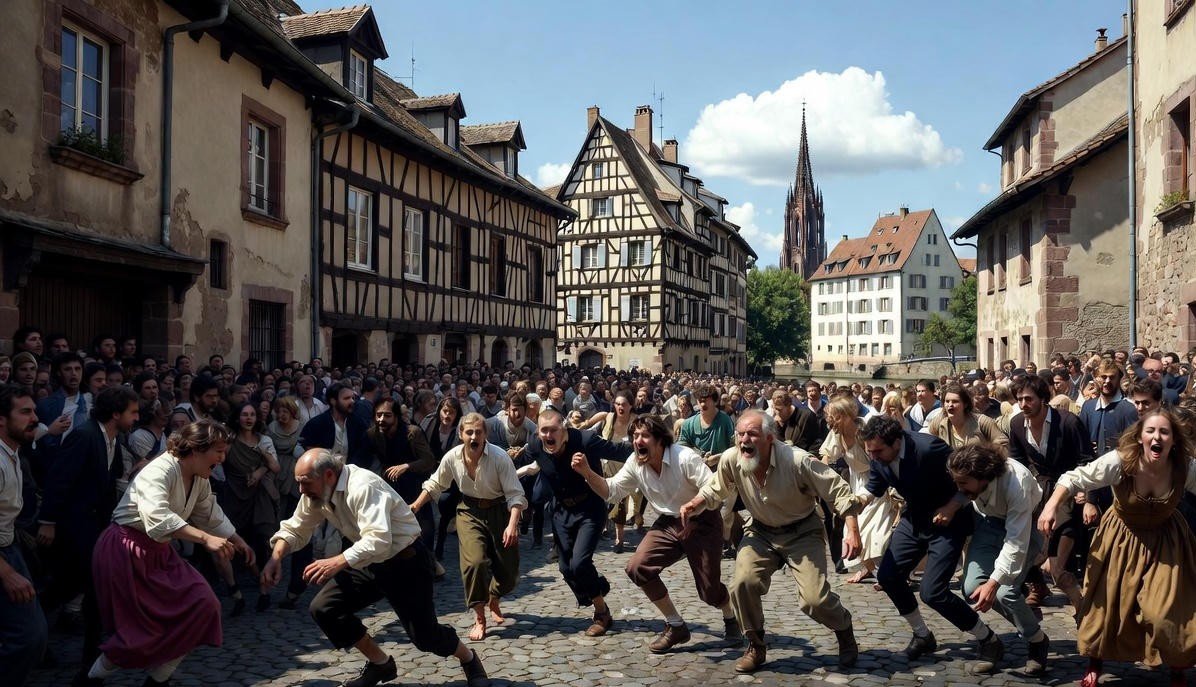
    On a sweltering July afternoon in 1518, in the narrow cobblestone lanes of Strasbourg, a woman named Frau Troffea stepped out of her doorway and began to dance. There was no music, no festival, no wedding procession—just the ordinary clatter of carts and the distant tolling of the cathedral bells. She lifted her arms, twisted her hips, and moved as though pulled by invisible strings. Neighbors paused, smiled at first, assuming some private joy or perhaps a touch too much wine. But she did not stop. Hours bled into evening. Her feet stamped harder, her face flushed crimson, yet still she danced, her skirts whipping around her calves like a storm-tossed banner. By nightfall her shoes were shredded and her soles bled, but her body refused to rest.

    Within three days, thirty people had joined her. By the end of the week, four hundred.

    They danced in the squares, in the alleys, along the banks of the Ill River where the tanners dumped their stinking vats. Some laughed maniacally; others wept. Their eyes were wide, glassy, fixed on nothing. Musicians—summoned, astonishingly, by the city council—were brought in to provide steady rhythms, on the theory that if the sufferers could dance to proper music they might eventually tire and recover. Instead the drums and pipes only seemed to whip the frenzy higher. People collapsed, hearts bursting, ribs cracked from ceaseless heaving breaths. Corpses were carted away while the living danced over the spots where they fell.

    Imagine the smell: sweat, blood, urine, the sour reek of fear. Imagine the sound: hundreds of feet pounding in no shared tempo, like a hailstorm on a tin roof, punctuated by raw screams and the occasional thin, reedy tune from a desperate shawm player who no longer knew why he was playing.

    Physicians arrived with their long robes and longer Latin diagnoses. They spoke of “hot blood” rising to the brain, of an overheated choleric humor. The clergy muttered about St. Vitus, the martyr whose name had long been attached to twitching limbs and sudden convulsions; they called it St. Vitus’s Dance and prescribed prayer, exorcism, and pilgrimage. Astrologers blamed a malevolent conjunction of Mars and Saturn. No one suggested rest, water, shade, or quiet. Rest was the one thing the dancers could not achieve.

    In early September, as suddenly as it began, the mania ebbed. The survivors—those whose hearts had not ruptured, whose kidneys had not failed from dehydration—stumbled home or were carried there, hollow-eyed, feet swollen to twice their size. The city’s chroniclers tallied the dead at somewhere between dozens and hundreds; the exact number dissolved into rumor the way the dancers themselves had seemed to dissolve into motion.

    Five centuries later, in air-conditioned seminar rooms and humming MRI suites, we circle the same mystery with better tools yet no final certainty. Ergot poisoning—Claviceps purpurea, the fungus that twists rye into sclerotia laced with lysergic acid precursors—remains the leading suspect. A wet spring followed by scorching heat in 1518 had produced exactly the conditions ergot loves. The poorest citizens, dependent on cheap rye bread, would have eaten it in quantity. LSD-like compounds can trigger hallucinations, vasoconstriction, and, crucially, relentless motor activity. Modern clinicians have watched patients under similar alkaloids dance, twitch, or run until they drop.

    Yet ergot alone feels too tidy. Strasbourg in 1518 was a city on edge. Famine had stalked the countryside for years; the Little Ice Age was tightening its grip, harvests failing, grain prices soaring. Plague had swept through only a decade earlier. Protestant rumblings were already audible in the cathedral’s shadow. Superstition walked the streets in broad daylight: comets were omens, blood rained from clouds, children were born with teeth. When the fabric of meaning frays, the body sometimes speaks what the mind cannot. Psychologists now use the term “mass psychogenic illness,” once called “mass hysteria,” though the word hysteria still carries the old misogynistic scent. Whatever we name it, the dancing plague sits at the uneasy border where physiology and culture blur.

    Stand for a moment on the Place Saint-Thomas in modern Strasbourg, where tourists sip riesling under linden trees. The cathedral’s single spire still knifes into the sky exactly as it did in 1518. Beneath your feet, layers of history lie compressed like sedimentary rock: Roman castrum, medieval charnel house, Renaissance blood. Somewhere down there are the frantic footprints of Frau Troffea and the hundreds who followed her into that terrible, ecstatic exhaustion.

    What strikes deepest is not the explanation we may finally settle on—ergot, stress, suggestion, divine wrath—but the fragility it exposes. We like to believe the human creature is sovereign over its own flesh: that will can always master reflex, that reason can quiet the animal pulse. Yet every few centuries something slips the leash. A laugh in a Tanganyika boarding school spreads until girls convulse for months. A Sicilian village wakes convinced its water is poisoned and hundreds fall twitching. A medieval city dances itself to death because one woman could not stop moving her feet.

    The lesson is quiet and uncomfortable: we are not nearly as securely buttoned into our skins as we pretend. Under the right pressure—hunger, terror, belief, poison—the self can come undone in ways that look, from the outside, like pure madness. And sometimes the only mercy is that the music, eventually, stops.

  • Ma in Japanese Culture: The Profound Power of Negative Space, Silence, and the Interval Between Moments

    Ma in Japanese Culture: The Profound Power of Negative Space, Silence, and the Interval Between Moments

    -Carl Austins

    What if the most powerful element in art, conversation, and life itself is… nothing?

    Not emptiness as absence, but emptiness as possibility. In Japanese aesthetics, this “nothing” has a name: ma (間). The kanji is poetic in its simplicity—a sun (日) glimpsed through a gate (門)—light made meaningful precisely because it is framed by darkness.

    Most articles about Japan fixate on cherry blossoms, samurai, or sushi. Few explore ma, yet it is the invisible thread running through traditional music, architecture, gardens, tea ceremony, Noh theater, sumi-e painting, and even modern minimalist design. Master the concept of ma, and you begin to see why Japanese spaces feel expansive, why silences feel pregnant rather than awkward, and why restraint so often communicates more than excess.

    This is the hidden key to understanding Japanese culture at its deepest level—and one that Western minds, trained to abhor a vacuum, urgently need today.

    What Is Ma, Exactly? (The Definition Most People Get Wrong)

    The most common translation is “negative space” or “gap.” That’s accurate but shallow.

    A better translation is “the space between.” Between sounds. Between movements. Between words. Between people. Between now and what comes next.

    Architect Arata Isozaki, who collaborated with Tadao Ando and helped introduce Japanese minimalism to the West, called ma “the natural pause or interval between two or more phenomena occurring jointly or successively.” Phenomenologist Kimura Bin preferred to describe it as “experiential time-space-time”—a single indivisible field in which subject and object arise together.

    In short: ma is not the absence of something. It is the presence of relationship.

    Where You’ve Felt Ma Without Realizing It

    • The breath-held silence after the final note of a shakuhachi solo
    • The deliberate pause in a tea ceremony before the bowl is turned
    • The vast white space in a sumi-e painting that makes the single brushstroke of a mountain feel infinite
    • Ozu’s static camera lingering on an empty corridor long after the characters have left
    • The moment in conversation when a Japanese person waits—really waits—before replying

    These are not accidents or flaws. They are the composition.

    The Perspective Almost Everyone Misses: Ma as a Moral and Psychological Technology

    Popular treatments frame ma as an aesthetic preference. That’s the tourist level.

    The deeper, rarely discussed level is ethical.

    In a culture built on interdependence (wa), ma is the lubricant that prevents friction. The tiny silence before answering is not evasion; it is radical respect—it grants the speaker’s words their full weight. Anthropologist Takie Sugiyama Lebra called this “anticipatory empathy”: you read the unspoken so sensitively that interruption becomes impossible.

    During the 2011 Great East Japan Earthquake, foreign media marveled at the orderly queues and absence of looting. They called it “stoicism.” Japanese observers more often reached for gaman (perseverance), but the deeper mechanism was ma: the collective willingness to let time do emotional labor, to allow space for shared grief instead of individual panic.

    The Contrarian Critique That Deserves a Hearing

    Not everyone celebrates ma.

    Feminist scholar Chizuko Ueno and others have argued that the burden of maintaining harmonious intervals has historically fallen on women—who must suppress opinions, soften language, absorb tension. The pressure to “read the air” (kūki o yomu) can become emotional labor taken to pathological extremes. The slang insult “KY” (kūki yomenai—cannot read the air) reveals how quickly sensitivity can flip into social control.

    Young Japanese creators—especially in manga, fashion, and music—are increasingly rejecting ma in favor of maximalism, color overload, and direct speech. Harajuku street style, Vocaloid concerts, and the chaotic energy of TikTok Japan can be read as a generational revolt against enforced silence.

    These critiques are valid. Like any powerful cultural tool, ma can be weaponized. The salaryman who lets the meeting room hang in terrified silence before speaking is not practicing Zen—he is asserting hierarchy.

    Yet even the critics rarely abandon ma entirely; they renegotiate its boundaries. That tells us something important: the concept is too fundamental to discard, only to reform.

    How to Practice Ma in a World That Punishes Pause (Practical Applications for 2025)

    1. In conversation: Wait four full seconds before replying. Watch what emerges.
    2. In writing: Leave more white space. Let paragraphs breathe.
    3. In design: Remove one element from every slide, email, or room. See what happens.
    4. In music/playlists: Insert ten seconds of silence between tracks. Notice the difference.
    5. In life: Schedule “nothing” blocks in your calendar and defend them ruthlessly.

    The apps that promise productivity through constant input are selling the opposite of ma is the original productivity hack—it’s just free, and it scales infinitely.

    Final Thought: The Gift Japan Is Still Trying to Give Us

    We are drowning in content, notification, opinion, stuff. Japan’s quiet insistence on interval—on the power of what is not said, not built, not filled—feels almost subversive now.

    But subversion is exactly what we need.

    The sun through the gate. The note that ends, and the silence that follows. The moment you stop scrolling and simply notice the space between one breath and the next.

    That space is ma. And it has been waiting for us, patiently, for fifteen hundred years.

    -Carl Austins

  • The Real Reason We Have Seasons: I Still Get Chills Every Time I Think About This — And You Will Too Once You See It Clearly

    The Real Reason We Have Seasons: I Still Get Chills Every Time I Think About This — And You Will Too Once You See It Clearly

    By Carl Austin November 20, 2025

    I’m going to confess something that embarrasses me every single time I say it out loud.

    For years — years! — I carried around the vague belief that summer happened because Earth swooped closer to the Sun, like a moth flirting with a flame. I’m talking well into my thirties, after I’d already written essays on quantum mechanics and climate modeling. I knew the orbit was elliptical, nodded sagely when someone mentioned perihelion, and still quietly assumed distance was the main driver.

    Then one night in 2018, watching a lame YouTube explainer at 2 a.m. because insomnia is undefeated, the globe-and-lamp demonstration hit me like a religious conversion. I actually paused the video, grabbed a soccer ball and my bedside lamp, and tried it myself. When the Arctic Circle suddenly bathed in perpetual light while Antarctica vanished into endless night, I felt the same electric jolt I got the first time I understood evolution or general relativity.

    I sat there in the dark, lamp humming, and whispered to myself: “Holy hell. We’ve all been wrong about something this basic.”

    And reader, we are. All of us. Harvard graduates, NASA engineers, BBC documentary narrators — surveys keep showing 70–80 % of educated adults get this wrong. Private surveys of MIT freshmen, British secondary school teachers, even planetarium staff. Same result, year after year.

    The real cause of seasons is so much weirder, so much more beautiful, and so much more consequential than “closer/farther” that once you internalize it, the entire sky feels different.

    The Distance Myth Dies Hard — Let Me Kill It for You Gently

    Yes, Earth’s orbit is elliptical. Yes, we’re about 5 million kilometers closer in January than July. Yes, that 3.3 % difference matters — it’s why Southern Hemisphere summers are very slightly hotter and more extreme than Northern ones (they get the perihelion boost). But 7 % more solar energy is peanuts compared to the 100 % difference between noon and midnight.

    If distance ruled, both hemispheres would peak together. Instead, when Buenos Aires is sweltering, Stockholm is frozen. The hemispheres are perfectly out of phase. Distance cannot explain that. Full stop.

    Watch What Happens When You Tilt the World

    Picture this: Earth is a spinning top that got whacked billions of years ago and never quite righted itself. It leans 23.5° off vertical — always the same direction, toward Polaris — as it circles the Sun.

    That lean is everything.

    In June, my hemisphere (Northern) is cocked toward the Sun like a flower following the light. The Sun climbs ridiculously high at noon, blasts us almost straight down, and refuses to set for hours and hours. Daylength in New York stretches to 15 hours; in Stockholm, the Sun barely dips below the horizon. More hours + more intense rays = summer.

    In December, we’re tilted away. The Sun sulks low in the sky, sunlight slants through miles more atmosphere, spreads over twice the surface area, and we get maybe 9 hours of weak, watered-down light. Winter.

    That’s it. That one fixed tilt, combined with spin and orbit, writes every spring bloom, every autumn color, every harvest festival humanity ever invented.

    I still get goosebumps demonstrating this to my kids with a basketball and a flashlight. Try it tonight. Seriously. I’ll wait.

    The Part That Actually Keeps Me Awake: We Almost Didn’t Get Seasons At All

    Here’s the perspective almost nobody ever mentions, and it haunts me in the best way.

    That glorious 23.5° tilt? It’s battle damage.

    4.5 billion years ago, a rogue protoplanet the size of Mars — we call her Theia — slammed into baby Earth at 40,000 km/h. The impact was so apocalyptic it melted both worlds, sprayed a ring of vaporized rock into orbit, and that debris coalesced into our Moon.

    Without Theia, Earth would probably spin bolt upright like Venus. Venus has a tilt of ~3°. Its days are longer than its years, its surface is 460 °C everywhere, and temperature barely varies from equator to pole. No seasons. Just eternal, crushing sameness.

    Instead, Theia’s gift was:

    • A 23.5° lean that paints the planet with seasons
    • A huge Moon that acts like a stabilizer gyro, keeping our tilt from wobbling wildly (poor Mars flips from 0° to 60° over millions of years, turning from temperate to ice hell and back)
    • Probably the kick that started plate tectonics, which keep Earth’s carbon cycle breathing

    The same catastrophe that birthed the Moon birthed springtime, autumn leaves, monsoon rains, Arctic terns migrating 80,000 km a year, and every human poem ever written about winter ending.

    I mean, come on. That’s not just science. That’s mythology that actually happened.

    The Contrarian Whisper I Can’t Quite Silence

    There’s a minority view in exoplanet circles — held by people far smarter than me, like Darren Williams and Peter Schulze — that large tilts might actually be bad for complex life. Uranus is tilted 98° and endures 42-year days and 42-year nights. Any biosphere there would need insane adaptations.

    They argue the ideal might be 10–15°, giving gentle seasons without polar ice caps or equatorial scorch. Earth’s 23.5° is borderline rowdy. Our ice ages, mass extinctions, and the fact that most of Earth’s landmass sits in the temperate zones may all trace back to that one drunken lean.

    I wrestle with this. Part of me loves the drama of our seasons — the evolutionary fire they lit under life. Another part wonders if a calmer world might have produced wiser civilizations that never invented war because they never had to store food for winter.

    But then I watch the maple outside my window turn scarlet in October, and I’m Team 23.5° forever.

    Why This Matters More Than Ever in 2025

    We’re warping the climate overlaying this ancient rhythm — making summers longer, winters weirder, extremes more extreme. But the geometry is still there, still governing everything. Understanding it helps you feel, not just know, why the Arctic is melting so catastrophically (low-angle sunlight is fragile; small forcing = huge change) and why Australia’s bushfire season is becoming apocalyptic (summer at perihelion + climate change is a terrifying combo).

    Most of all, it restores wonder.

    Next time you step outside on the summer solstice and the Sun hangs impossibly high, or on a December afternoon when it’s already dark at 4 p.m., remember: you are feeling the echo of a cosmic car crash that happened when the oceans were still magma. That crash gave us Beethoven’s Pastoral Symphony, Persian poetry about spring, Canadian maple syrup, and the entire concept of “the holidays.”

    We didn’t just luck into habitable. We lucked into beautiful.

    And every year, like clockwork, the tilted Earth reminds us.

    Carl Austin writes about the ideas that keep him awake at night. If this piece gave you the same chills it still gives me, share it with someone who deserves to feel small and enormous at the same time.

  • The OpenAI Reckoning: I’ve Been Watching This Slow-Motion Car Crash for Years—And This Week It Finally Hit the Wall

    The OpenAI Reckoning: I’ve Been Watching This Slow-Motion Car Crash for Years—And This Week It Finally Hit the Wall

    By Carl Austin November 20, 2025

    I’m going to be blunt: when I saw those resignation letters drop on Tuesday night, I felt something close to grief.

    Not surprise—God no, the surprise burned off sometime around the third “restructuring” in 2023—but genuine, gut-level sorrow. Because these weren’t anonymous Twitter egg accounts screaming into the void. These were the people who taught me, and half the field, how to think rigorously about alignment in the first place. And they just said, in public, that the institution they helped build is no longer salvageable.

    That hurts. It should hurt all of us.

    The Moment the Mask Slipped

    Let me paint the scene for you the way it actually felt in the group chats I’m still in (yes, the invites never quite get revoked).

    Monday: Sam on stage, smiling that practiced smile, unveiling the Superintelligence Governance Board like it’s the second coming of the Charter. Wednesday morning: seven letters, each more scalding than the last, hit the shared drive. By lunchtime the Slack channel was a ghost town. By dinner, the phrase “security theater” was trending.

    I’ve read every public resignation from OpenAI since 2021. These ones are different. They don’t plead. They don’t negotiate. They simply state, with exhausted clarity: We are done.

    The Part Nobody Wants to Say Out Loud

    Here’s the sentence that keeps me awake: the Governance Board was the biggest concession Sam Altman has ever made—and the safety people still walked.

    Think about that. They were offered a seat at the absolute top table. Veto power. Twelve-month delays if needed. A direct line to the release valve on superintelligence itself.

    And they looked at it, looked at who the board ultimately answers to, looked at the Microsoft cap-table looming in the background like a silent partner in the room, and said: No. This cannot be fixed from the inside.

    That is not a policy disagreement anymore. That is a declaration of institutional bankruptcy.

    The Contrarian Who Lives in My Head (and Is Getting Louder)

    Of course there’s another voice—and it’s a voice I respect—that says: “Carl, you’re being dramatic. These people have been moving the goalposts for five straight years.”

    And honestly? That voice has a point.

    2019: “Solve alignment before AGI.” 2021: “At least give us scalable oversight.” 2023: “Fine, just give us a serious superalignment effort.” 2024: “Okay, but keep the team together.” 2025: “Actually, no internal structure under investor pressure can ever work; the only moral choice is total refusal.”

    At some point, yes, this starts to look less like principled caution and more like the labor theory of value for existential risk: only the safety researchers get to decide when humanity is ready, and the answer is apparently never under current economic reality.

    I feel the force of that argument. I really do. Because the alternative—watching the capability curve go parabolic while the people who understand the danger most viscerally refuse to engage—feels like watching someone burn down the fire station during a wildfire.

    The Ghost of Los Alamos Keeps Whispering

    Every time this happens I think of Leo Szilard in 1945, circulating his petition against using the bomb, collecting signatures, watching it get buried by Groves and Oppenheimer. Szilard was right about the moral horror. Oppenheimer was right that the world had already changed and someone would build it.

    We never really resolved that argument. We just lived with the fallout—literal and moral—for eighty years.

    The difference now is speed. Szilard had months to organize. We have weeks.

    My Own Position, Since You Asked

    I’m not neutral. I never really was.

    I believe we are going to build superintelligence in this decade. I believe the default outcome, absent heroic effort, is catastrophic. And I believe the heroic effort is no longer possible inside the current OpenAI.

    That leaves three paths:

    1. The company somehow rights the ship against all precedent.
    2. The accelerationists win and we roll the dice.
    3. The safety community finally admits that winning inside the existing labs is impossible and starts building the alternative institutions we’ve been talking about since 2016.

    I am begging—actually begging—for door number three.

    Because door number two is how civilizations die screaming, and door number one feels, at this point, like a fantasy we tell ourselves so we can sleep.

    A Personal Note to the People Who Just Left

    If any of you are reading this: thank you. Seriously. Your letters were acts of courage that most of us (myself very much included) have never matched.

    But please—don’t stop here. The world needs the thing you build next more than it has ever needed anything. Not another scaling lab. Not another critique from the sidelines.

    Something new. Something that proves superintelligence can be pursued without selling your soul to the growth gods. I don’t know what it looks like yet. But I know you’re the only ones who can invent it.

    And if you do, I’ll be first in line to fund it, cheer it, defend it.

    Because this isn’t just about OpenAI anymore.

    It’s about whether humanity gets to keep a seat at the table we’re building.

    And right now, that seat is looking awfully empty.

    Carl Austin is an independent writer covering the intersection of technology, ethics, and the future of intelligence. You can find his archive at ThinkForgeHub.com

  • I Just Read the Paper That Made Me Put My Coffee Down and Stare Out the Window for a Solid Twenty Minutes

    I Just Read the Paper That Made Me Put My Coffee Down and Stare Out the Window for a Solid Twenty Minutes

    The gene we threw away fifteen million years ago is suddenly back in the lab—and it might actually fix two diseases that have quietly ruined more lives than most of us realize.

    I’m going to level with you: I have friends who wake up at 3 a.m. convinced someone is driving a railroad spike through their big toe. I have other friends who were told their liver numbers were “borderline” and then, five silent years later, learned the word “cirrhosis” is no longer theoretical. Over a hundred million Americans are currently losing this slow, invisible war against uric acid, and the best medicine has offered so far is a daily pill that barely keeps the monster asleep while it slowly eats your kidneys.

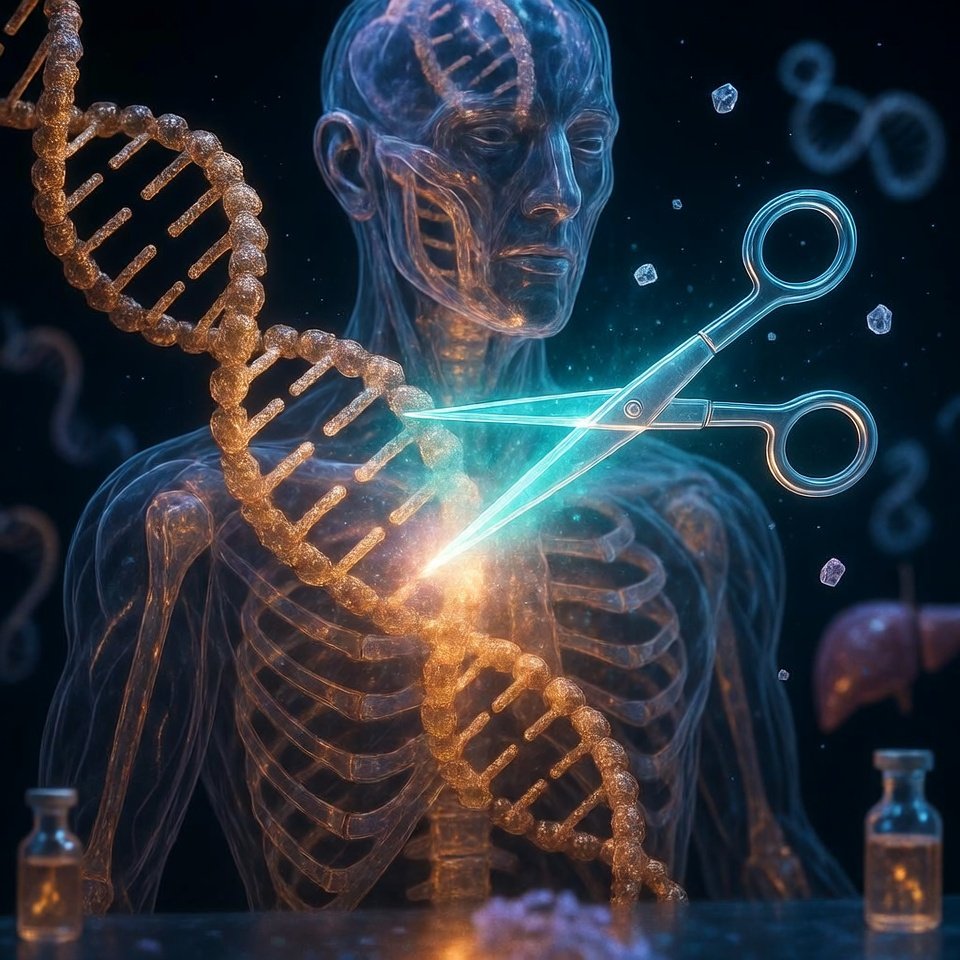
    Then last week (November 14, 2025, Nature Genetics) a team at Penn casually announced they’d used CRISPR to resurrect the exact gene our primate ancestors trashed fifteen million years ago. The gene is called UOx. It makes urate oxidase—the enzyme that turns uric acid into harmless allantoin. Every dog, cat, rat, and sparrow on the planet still has it. We great apes do not.

    They slipped a tiny CRISPR switch into human liver cells, turned the broken gene back on, and watched uric acid plummet seventy percent. Fat stopped accumulating. Inflammation vanished. No off-target chaos. Just a primate quietly remembering how to do something every squirrel takes for granted.

    I actually laughed out loud in my kitchen. One infusion. One time. Done.

    The part that genuinely haunts me

    This isn’t some shiny new designer gene. This is our gene—rusted shut, gathering dust in the genome like an heirloom sword nobody bothered to sharpen. All we had to do was walk back into the attic and pick it up.

    I’ve spent years chasing down the footnotes that mainstream medicine ignores, and the story checks out. Evolution ditched UOx because, back when famines were annual and the sweetest thing on the savanna was an overripe fig, a little extra uric acid probably acted as an antioxidant and helped us grow bigger brains. Cute trick—until high-fructose corn syrup showed up and turned that ancient hack into a loaded gun.

    The quiet papers nobody cites (until now)

    There’s a 2014 hypothesis by Richard Johnson at Colorado that got dismissed as “overly elegant.” He argued the loss of UOx is the hidden trigger for the entire metabolic syndrome cluster—gout, fatty liver, hypertension, diabetes. Last week’s paper just handed him the microphone and a standing ovation.

    And the part nobody wants to say out loud yet

    Gout hits Black and Pacific Islander communities hardest. NAFLD is exploding in Hispanic children. Meanwhile, gene-therapy manufacturing still costs north of two million dollars a dose. So the question isn’t whether this will work in a lab. The question is who gets to become a fully functional primate again, and who gets stuck with the evolutionary hangover because the price tag is obscene.

    Where I actually land on this

    I’m excited in a way I rarely let myself be. For the first time, a pair of diseases that feel personal to half the people I love might become optional. But excitement without memory is reckless. We have to remember the gene was never the villain; the environment changed. We changed it.

    If we’re brave enough to hand this fix to the very communities evolution short-changed the hardest, then maybe we’ll have done something genuinely worth writing home about.

    Until then, I’m keeping the cherry juice in the fridge and the PDF bookmarked. Some ghosts are absolutely worth waking up.

    — Carl Austin
    Still hoping my friends never have to learn what a gout flare feels like at 3 a.m.