By: Carl Austins
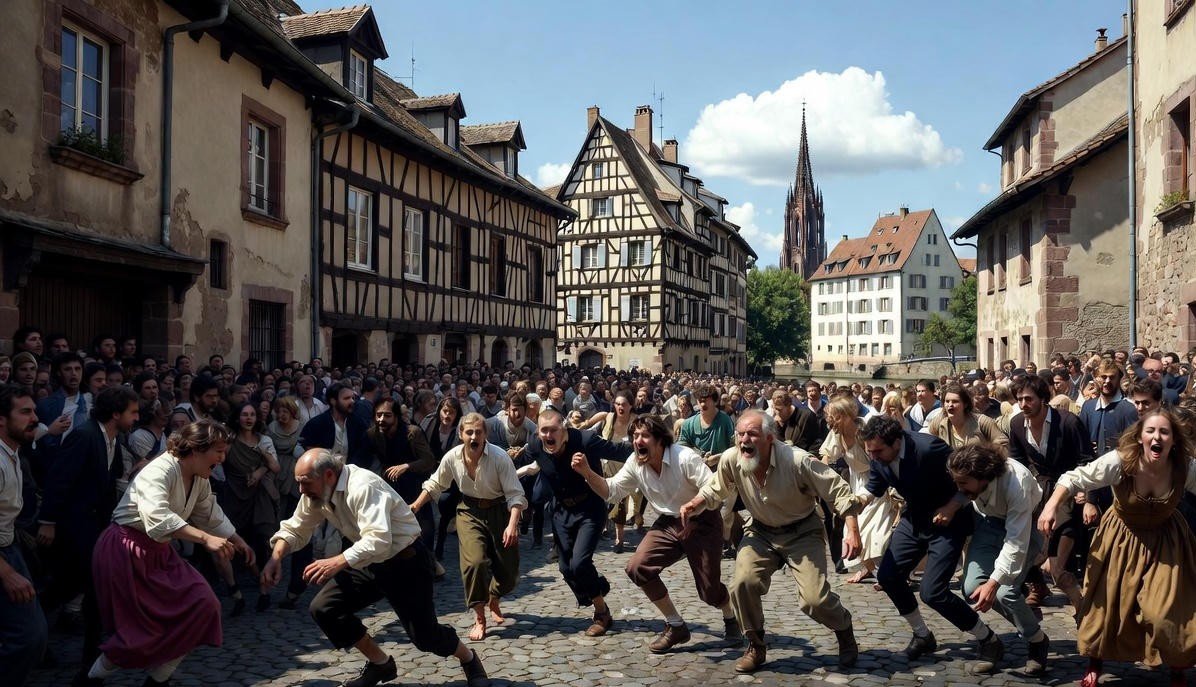
On a sweltering July afternoon in 1518, in the narrow cobblestone lanes of Strasbourg, a woman named Frau Troffea stepped out of her doorway and began to dance. There was no music, no festival, no wedding procession—just the ordinary clatter of carts and the distant tolling of the cathedral bells. She lifted her arms, twisted her hips, and moved as though pulled by invisible strings. Neighbors paused, smiled at first, assuming some private joy or perhaps a touch too much wine. But she did not stop. Hours bled into evening. Her feet stamped harder, her face flushed crimson, yet still she danced, her skirts whipping around her calves like a storm-tossed banner. By nightfall her shoes were shredded and her soles bled, but her body refused to rest.
Within three days, thirty people had joined her. By the end of the week, four hundred.
They danced in the squares, in the alleys, along the banks of the Ill River where the tanners dumped their stinking vats. Some laughed maniacally; others wept. Their eyes were wide, glassy, fixed on nothing. Musicians—summoned, astonishingly, by the city council—were brought in to provide steady rhythms, on the theory that if the sufferers could dance to proper music they might eventually tire and recover. Instead the drums and pipes only seemed to whip the frenzy higher. People collapsed, hearts bursting, ribs cracked from ceaseless heaving breaths. Corpses were carted away while the living danced over the spots where they fell.
Imagine the smell: sweat, blood, urine, the sour reek of fear. Imagine the sound: hundreds of feet pounding in no shared tempo, like a hailstorm on a tin roof, punctuated by raw screams and the occasional thin, reedy tune from a desperate shawm player who no longer knew why he was playing.
Physicians arrived with their long robes and longer Latin diagnoses. They spoke of “hot blood” rising to the brain, of an overheated choleric humor. The clergy muttered about St. Vitus, the martyr whose name had long been attached to twitching limbs and sudden convulsions; they called it St. Vitus’s Dance and prescribed prayer, exorcism, and pilgrimage. Astrologers blamed a malevolent conjunction of Mars and Saturn. No one suggested rest, water, shade, or quiet. Rest was the one thing the dancers could not achieve.
In early September, as suddenly as it began, the mania ebbed. The survivors—those whose hearts had not ruptured, whose kidneys had not failed from dehydration—stumbled home or were carried there, hollow-eyed, feet swollen to twice their size. The city’s chroniclers tallied the dead at somewhere between dozens and hundreds; the exact number dissolved into rumor the way the dancers themselves had seemed to dissolve into motion.
Five centuries later, in air-conditioned seminar rooms and humming MRI suites, we circle the same mystery with better tools yet no final certainty. Ergot poisoning—Claviceps purpurea, the fungus that twists rye into sclerotia laced with lysergic acid precursors—remains the leading suspect. A wet spring followed by scorching heat in 1518 had produced exactly the conditions ergot loves. The poorest citizens, dependent on cheap rye bread, would have eaten it in quantity. LSD-like compounds can trigger hallucinations, vasoconstriction, and, crucially, relentless motor activity. Modern clinicians have watched patients under similar alkaloids dance, twitch, or run until they drop.
Yet ergot alone feels too tidy. Strasbourg in 1518 was a city on edge. Famine had stalked the countryside for years; the Little Ice Age was tightening its grip, harvests failing, grain prices soaring. Plague had swept through only a decade earlier. Protestant rumblings were already audible in the cathedral’s shadow. Superstition walked the streets in broad daylight: comets were omens, blood rained from clouds, children were born with teeth. When the fabric of meaning frays, the body sometimes speaks what the mind cannot. Psychologists now use the term “mass psychogenic illness,” once called “mass hysteria,” though the word hysteria still carries the old misogynistic scent. Whatever we name it, the dancing plague sits at the uneasy border where physiology and culture blur.
Stand for a moment on the Place Saint-Thomas in modern Strasbourg, where tourists sip riesling under linden trees. The cathedral’s single spire still knifes into the sky exactly as it did in 1518. Beneath your feet, layers of history lie compressed like sedimentary rock: Roman castrum, medieval charnel house, Renaissance blood. Somewhere down there are the frantic footprints of Frau Troffea and the hundreds who followed her into that terrible, ecstatic exhaustion.
What strikes deepest is not the explanation we may finally settle on—ergot, stress, suggestion, divine wrath—but the fragility it exposes. We like to believe the human creature is sovereign over its own flesh: that will can always master reflex, that reason can quiet the animal pulse. Yet every few centuries something slips the leash. A laugh in a Tanganyika boarding school spreads until girls convulse for months. A Sicilian village wakes convinced its water is poisoned and hundreds fall twitching. A medieval city dances itself to death because one woman could not stop moving her feet.
The lesson is quiet and uncomfortable: we are not nearly as securely buttoned into our skins as we pretend. Under the right pressure—hunger, terror, belief, poison—the self can come undone in ways that look, from the outside, like pure madness. And sometimes the only mercy is that the music, eventually, stops.