
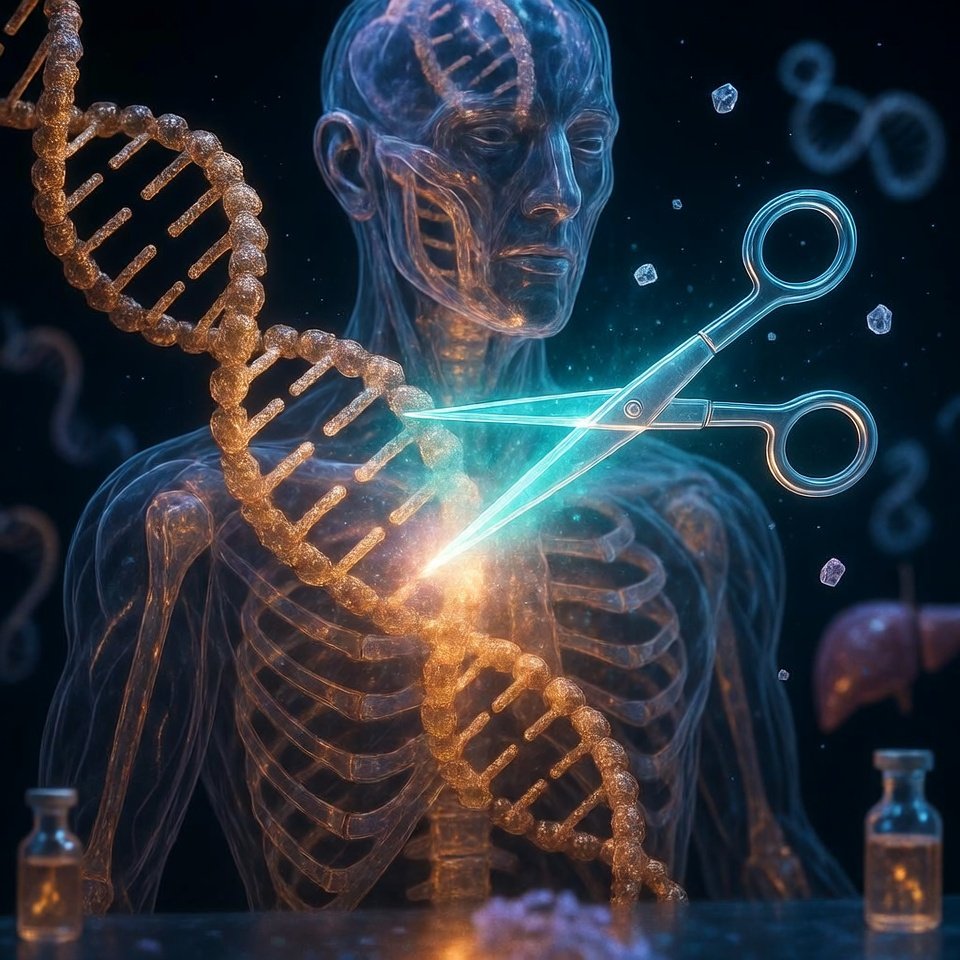
The gene we threw away fifteen million years ago is suddenly back in the lab—and it might actually fix two diseases that have quietly ruined more lives than most of us realize.
I’m going to level with you: I have friends who wake up at 3 a.m. convinced someone is driving a railroad spike through their big toe. I have other friends who were told their liver numbers were “borderline” and then, five silent years later, learned the word “cirrhosis” is no longer theoretical. Over a hundred million Americans are currently losing this slow, invisible war against uric acid, and the best medicine has offered so far is a daily pill that barely keeps the monster asleep while it slowly eats your kidneys.
Then last week (November 14, 2025, Nature Genetics) a team at Penn casually announced they’d used CRISPR to resurrect the exact gene our primate ancestors trashed fifteen million years ago. The gene is called UOx. It makes urate oxidase—the enzyme that turns uric acid into harmless allantoin. Every dog, cat, rat, and sparrow on the planet still has it. We great apes do not.
They slipped a tiny CRISPR switch into human liver cells, turned the broken gene back on, and watched uric acid plummet seventy percent. Fat stopped accumulating. Inflammation vanished. No off-target chaos. Just a primate quietly remembering how to do something every squirrel takes for granted.
I actually laughed out loud in my kitchen. One infusion. One time. Done.
The part that genuinely haunts me
This isn’t some shiny new designer gene. This is our gene—rusted shut, gathering dust in the genome like an heirloom sword nobody bothered to sharpen. All we had to do was walk back into the attic and pick it up.
I’ve spent years chasing down the footnotes that mainstream medicine ignores, and the story checks out. Evolution ditched UOx because, back when famines were annual and the sweetest thing on the savanna was an overripe fig, a little extra uric acid probably acted as an antioxidant and helped us grow bigger brains. Cute trick—until high-fructose corn syrup showed up and turned that ancient hack into a loaded gun.
The quiet papers nobody cites (until now)
There’s a 2014 hypothesis by Richard Johnson at Colorado that got dismissed as “overly elegant.” He argued the loss of UOx is the hidden trigger for the entire metabolic syndrome cluster—gout, fatty liver, hypertension, diabetes. Last week’s paper just handed him the microphone and a standing ovation.
And the part nobody wants to say out loud yet
Gout hits Black and Pacific Islander communities hardest. NAFLD is exploding in Hispanic children. Meanwhile, gene-therapy manufacturing still costs north of two million dollars a dose. So the question isn’t whether this will work in a lab. The question is who gets to become a fully functional primate again, and who gets stuck with the evolutionary hangover because the price tag is obscene.
Where I actually land on this
I’m excited in a way I rarely let myself be. For the first time, a pair of diseases that feel personal to half the people I love might become optional. But excitement without memory is reckless. We have to remember the gene was never the villain; the environment changed. We changed it.
If we’re brave enough to hand this fix to the very communities evolution short-changed the hardest, then maybe we’ll have done something genuinely worth writing home about.
Until then, I’m keeping the cherry juice in the fridge and the PDF bookmarked. Some ghosts are absolutely worth waking up.
— Carl Austin
Still hoping my friends never have to learn what a gout flare feels like at 3 a.m.