
By Carl Austins
I’m going to confess something that keeps me awake some nights: there is a colossal volcanic eruption (one of the ten biggest in two millennia) that literally changed the climate of the planet, turned sunsets the color of fresh blood for half a decade, helped trigger the last major subsistence crisis in Western Europe, inspired Frankenstein, and (this is the part that haunts me) we still don’t know where the hell it happened.
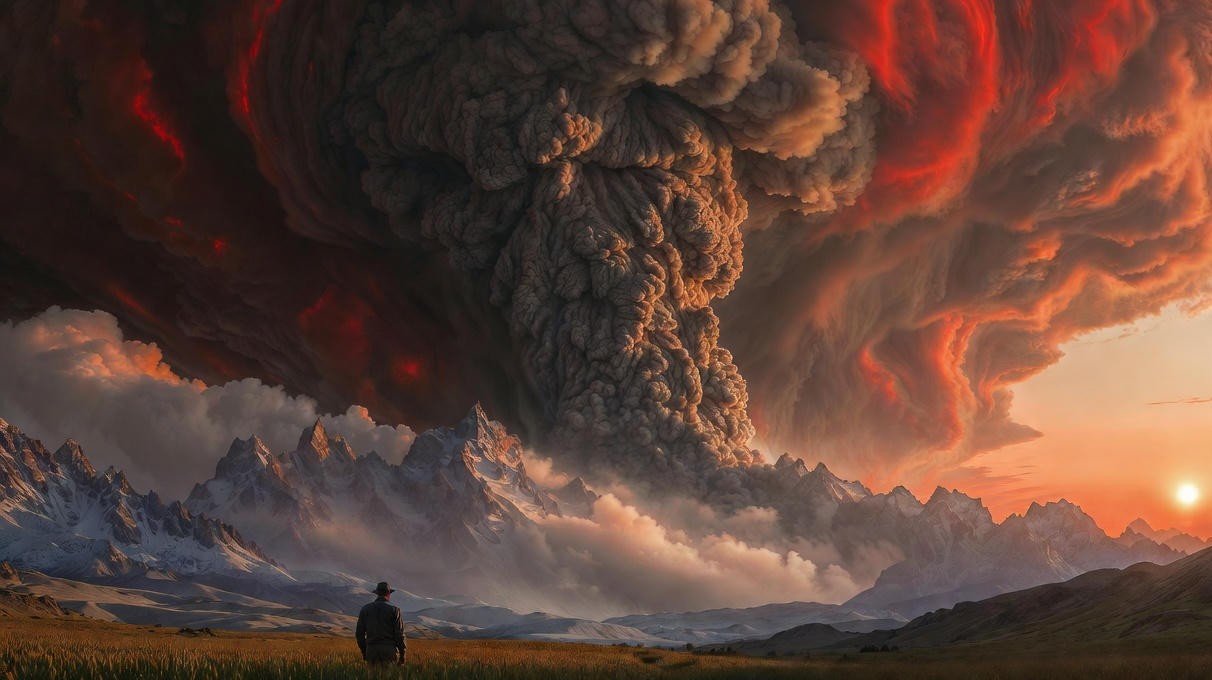
The year was 1809. Somewhere in the high, jungle-choked Andes of what is now Colombia or Ecuador, a mountain detonated with such fury that it punched a plume of ash and sulphur thirty kilometres into the stratosphere. No European saw it. No ship’s log recorded the roar. The Indigenous nations who must have watched their sky turn black for weeks left no written testimony that has survived Spanish archives and time. The crater itself? Either erased by later eruptions or simply swallowed again by equatorial rainforest. Gone.
And yet the evidence is screaming at us from every ice core drilled in Greenland and Antarctica: a sulphate spike in 1809–1810 that rivals Krakatau, followed six years later by the monster we all know, Tambora. Two gut punches to the global climate in less than a decade. The second one gets all the press. The first one (the opening act that softened the world up) is treated like a footnote.
I find that unforgivable.
Let me paint the scene for you the way it actually unfolded
Imagine you’re a farmer in Vermont, 1812. You’ve already endured two weirdly cold summers. Your wheat is stunted. Then one July morning you step outside and the sun rises the color of arterial blood. It stays that way for years. Snow in Hungary falls brown and gritty, tasting of brimstone when you put it on your tongue. Turner in London can’t paint fast enough (those apocalyptic skies we admire in galleries now were real-time reportage). Chinese mandarins write frantic memorials about purple suns and silk ruined by crimson rain. Bengal opium harvests collapse, and the first waves of indentured laborers are shipped out to plantations that will one day be called Guyana and Trinidad.
All because some mountain we can’t even name decided to rip itself apart on the far side of the planet.
The detective story that keeps me up
Since the 1990s, a handful of stubborn volcanologists (people like Tom Simkin, Steve Self, and later Shanaka de Silva) have been chasing this ghost eruption through ice cores, tree rings, and obscure 19th-century weather diaries. They’ve narrowed it down to a 2,000-kilometre stretch of the northern Andes, but every candidate volcano has an alibi. Galeras? Wrong chemistry. Puracé? Too small. There’s even a theory that the culprit was a short-lived, steam-blast “super-phreatic” event (essentially the Earth’s crust burped a continent-sized cloud of glass shards and never left a scar).
I love that idea, because it means our catalogues of “dangerous” volcanoes are probably missing an entire class of apocalypse.
Why this forgotten eruption feels personal right now
In 2025 we are seriously debating deliberate stratospheric sulphate injection (solar geoengineering). The models all cite Tambora and Pinatubo as analogues. Almost none of them bother to include the 1809 precursor event. That’s like stress-testing a bridge using only half the historical flood data.
We are proposing to do artificially what an anonymous mountain did by accident (twice in six years) and we still can’t find the first crime scene.
A closing thought I can’t shake
Mary Shelley wrote Frankenstein during the second of those blood-red summers, trapped indoors by endless rain, telling ghost stories by candlelight because the sun itself had turned hostile. She never knew the volcano’s name. Neither do we.
Maybe that’s the real warning: the events that most profoundly reshape human history are sometimes the ones that happen in perfect silence, half a world away from anyone who bothered to write them down.
And the atmosphere never forgets.
— Carl Austin
Somewhere under a normal-colored sunset, wondering what else we’ve missed.
Leave a Reply